


The Situation
The aim was to quantify russeting (the rough, brownish patches on apple skin) as an objective percentage of the fruit surface instead of a visual score. That needs the whole surface, and a sphere resists being imaged: a single view shows at most half of it, and Lambert's cosine law darkens the fruit towards its edges, so a dark rim is hard to tell apart from a dark blemish.
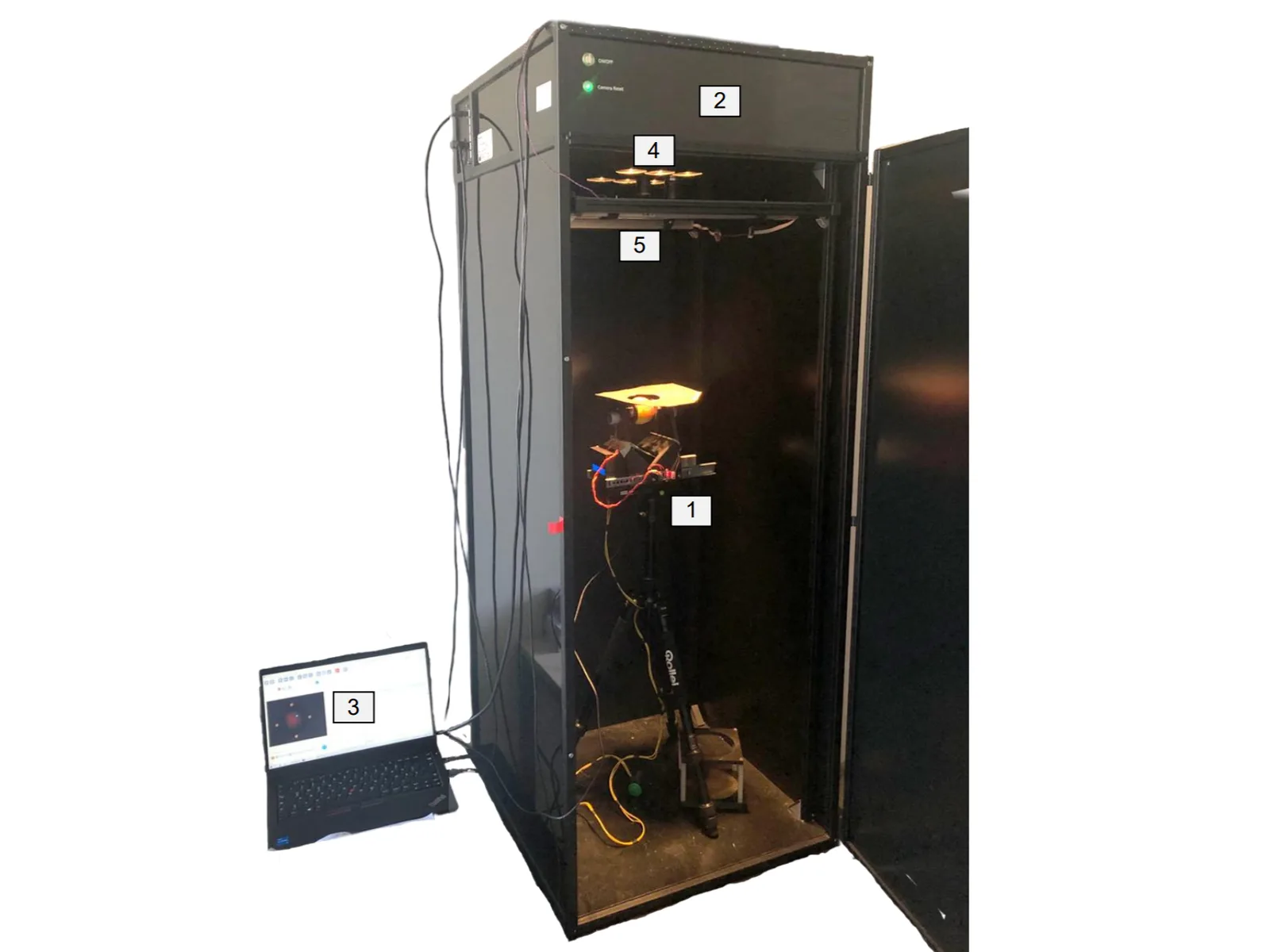
Imaging ran in a hyperspectral imaging cabinet covering 500–1000 nm, with a DSLR as the RGB alternative. What was missing was a way to turn the apple by exact, repeatable steps in time with each exposure, and to turn the resulting image series into one continuous, evenly lit map of the surface. Off-the-shelf rotation stages could not take the trigger from the imaging system, hold the irregular shape of real fruit, or be adapted quickly as requirements changed.
The Approach
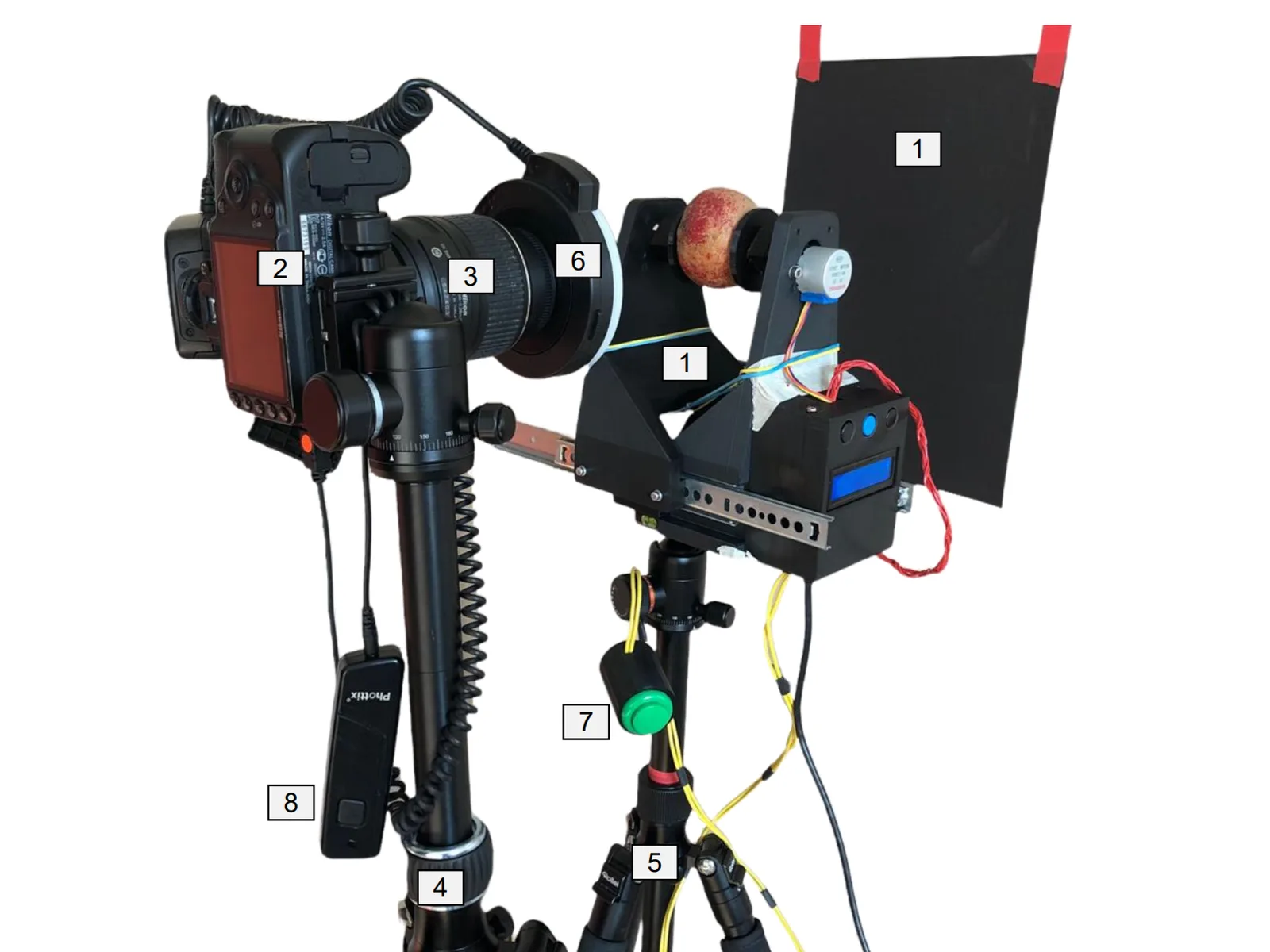
The Apple Rotator Device (ARD) was designed in CAD and mostly 3D printed in black PLA, black to keep stray reflections out of the images. Two clamps hold the apple at its poles, and two stepper motors turn it about a horizontal axis in steps of 0.176°. The device stands on a tripod.
An Arduino Nano running custom C++ firmware drives the motors. Each rotation step is triggered either by a push button or by a light sensor that detects the imaging system's lamps switching on, which keeps rotation and image capture in step.
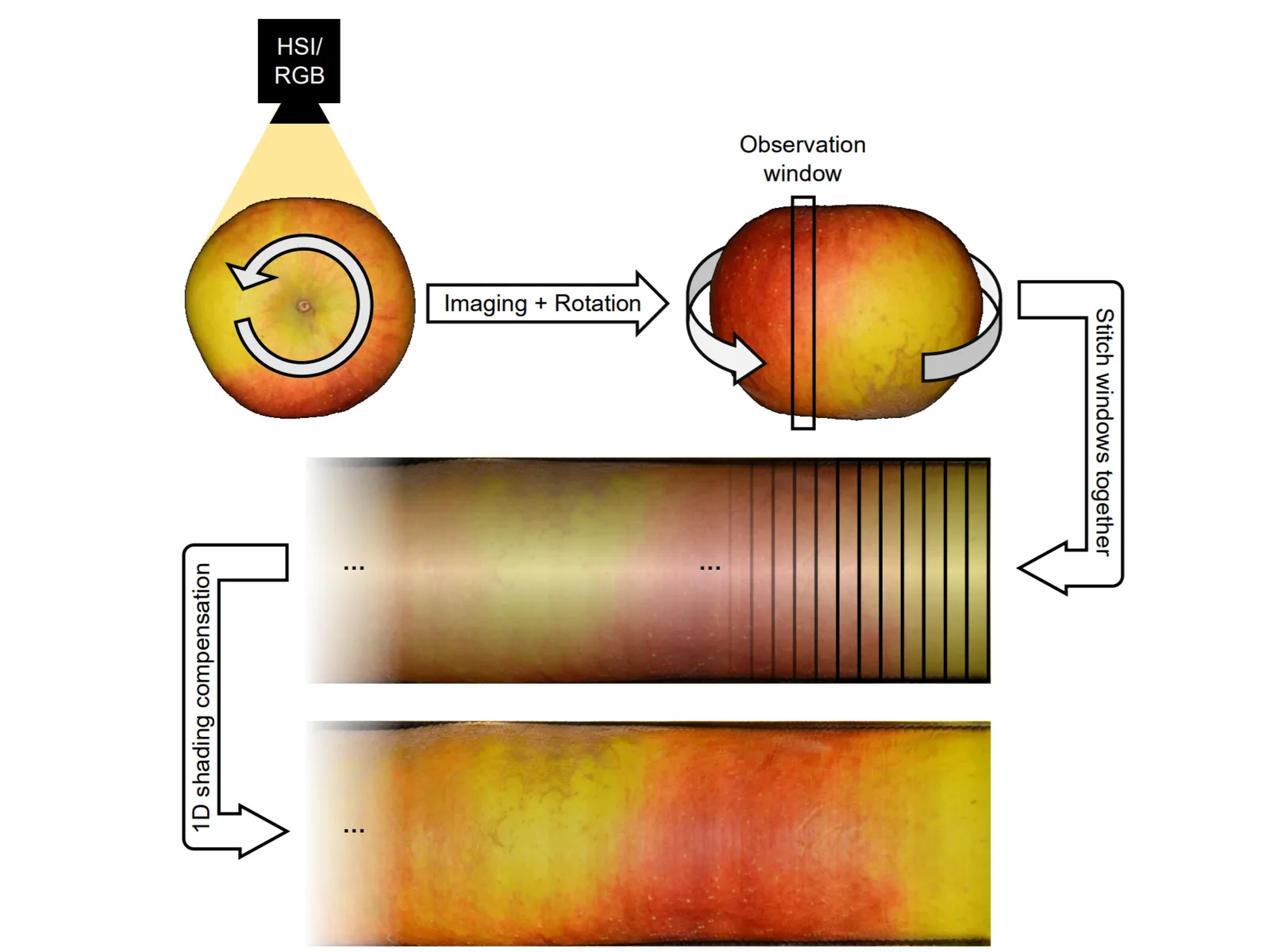
Processing is an entirely scripted Fiji pipeline. It loads the frames of one rotation, detects tracking dots in the background to centre each frame and remove small shifts between frames, cuts the narrow centre window out of every frame (the strip that faces the camera squarely and suffers least from cosine shading) and stitches the windows into a continuous 2D unrolling of the surface. Dividing that unrolling by a reference unrolling of a uniform cylinder then compensates the remaining shading.
The Result
One automated scan gives a flat map of the apple surface, 360° around the rotation axis; only the small areas under the clamps at the poles are not imaged. The tracking-dot alignment removes the jitter of uncorrected scans, and the shading compensation makes the brightness across the surface much more uniform, which is what makes the map usable for segmentation and machine learning.
The device works with the hyperspectral camera and with a DSLR. In the russeting study it served, the DSLR proved the better tool: RGB scans with a machine-learning classifier segmented russeted skin more robustly than the hyperspectral scans, with less equipment and less time. The most distinctive signal lies between 400 and 550 nm, largely below the 500–1000 nm range of the hyperspectral system.