


The Situation
The imagery came from a gantry-based high-throughput phenotyping platform that images plants from directly above in RGB and near-infrared, repeatedly over the season. A hundred plants with a few hundred leaves each is already tens of thousands of leaves per imaging date.
The bottleneck was not imaging, it was extraction. Existing tools could segment whole plants but not isolate individual leaves, and many analyses only want a small share of the leaves: fully visible from above, mature, healthy, well lit. Without leaf-level data on area, shape and spectral response, those traits stayed locked inside the images, and checking leaves by hand, even at one second each, does not scale to a season.
The Approach
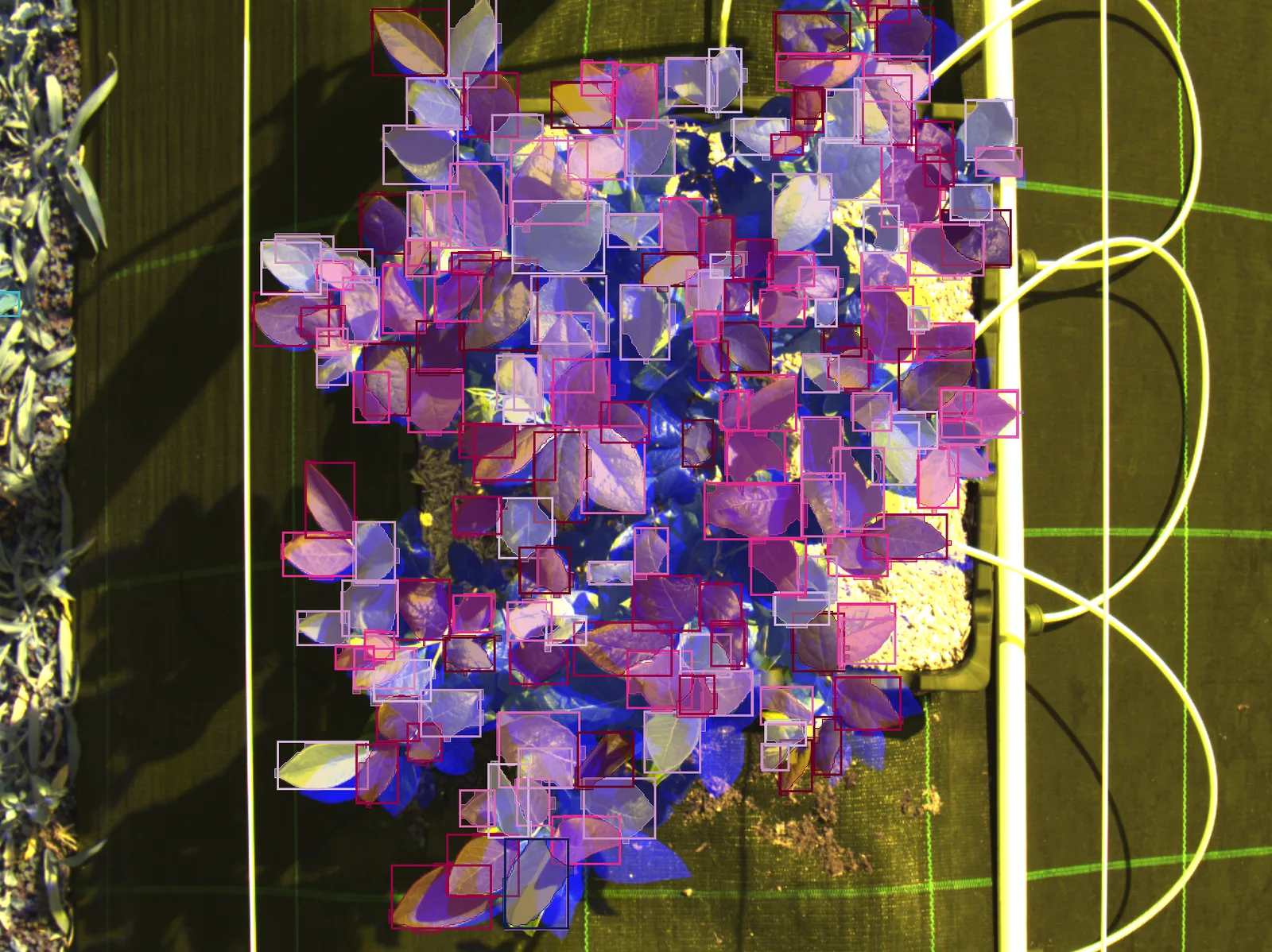
PhenoSelect is a two-stage deep-learning pipeline. The first stage, YOLOv11x-seg instance segmentation pretrained on COCO and fine-tuned on leaves, finds every leaf and delineates it with a pixel-level mask. The second stage, a ResNet-18 with one output head per trait, classifies each leaf cut-out for visibility, health, maturity and illumination, so a single filter on the results table selects the leaves worth analysing. The traits are user-defined and can be relabelled and retrained.
The segmentation model takes three input channels, so the blue channel of each image is replaced with the NIR1 band. Leaves reflect near-infrared strongly, which raises the contrast between leaf tissue and background, particularly in dense canopies where leaves overlap. Training used heavy augmentation (geometric, photometric, Mosaic, MixUp and Copy-Paste) to teach the model to separate overlapping leaves in cluttered scenes and across plant sizes.
Segmentation labels were drawn in AnyLabeling with model-assisted polygons, in rounds: label, train overnight on a CUDA GPU, check, label more. The final set was about 120 images across three species: Hosta, lily of the valley and blueberry. For the classifier, Moritz Nelle wrote a keyboard-driven labelling tool and labelled 700 leaf cut-outs with it.

The Result
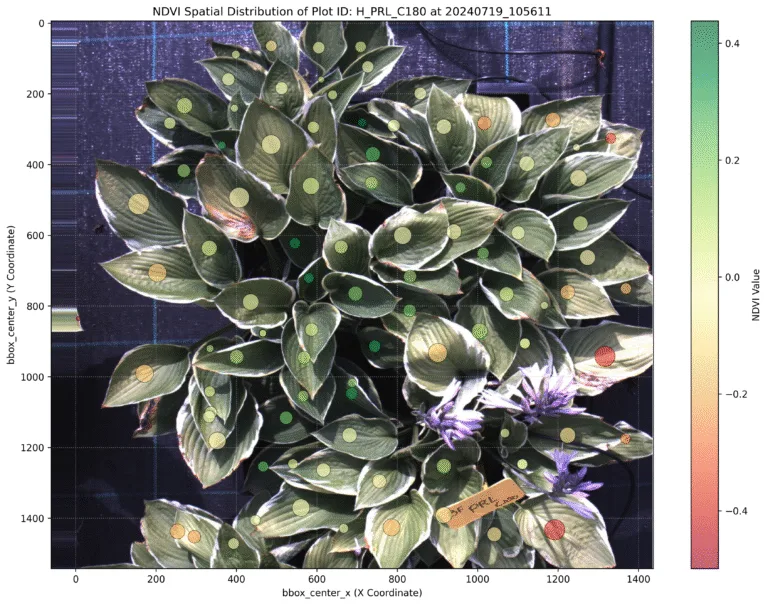
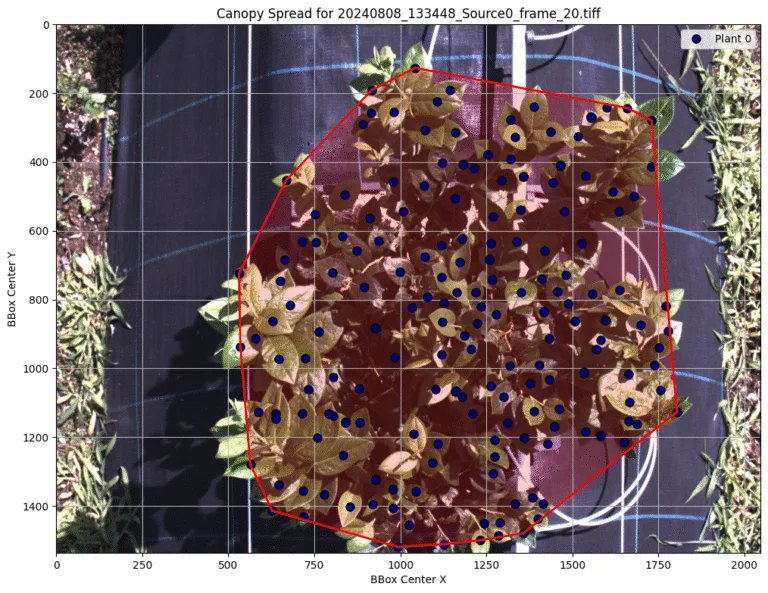
On the multi-species RGB-NIR dataset the segmentation model reached mAP50 0.949. For every image the pipeline writes one row per leaf (position, mask, area and class labels), plus leaf count, per-leaf mean and standard deviation of NDVI, and canopy spread, measured as the convex hull of the leaf centres. From that table it runs mixed-effects statistics and plots each trait over time per treatment.
The pipeline was also moved to a second sensor: hyperspectral images of blueberry from a different experiment, converted to RGB. Out of the box the model performed poorly on them. After training continued on 30 labelled hyperspectral images, it reached accuracy similar to the RGB-NIR model, so adapting to a new sensor costs a small labelling round rather than a new model.