Engineering studio · Wageningen, NL

Imaging, hardware, and the code between.

Hardware Software Image Data

Haystack Imaging builds custom imaging hardware, writes the firmware and software that runs it, and turns the captured imagery into clean, structured data. Deep in agriculture, at home anywhere a camera has to answer a question. Come in wherever the chain starts for you.

The haystack

Thousands of images. We find the Needle in the Haystack.

Field campaigns, breeding trials, greenhouse surveys, barn monitoring, lab imaging setups - they all generate more imagery than most teams have time to process. The measurements you actually need are buried somewhere in there. Turning those pixels into clean, analysis-ready numbers takes a rare combination of skills.

The same is true of the engineering around them. A camera that has to survive a barn, a pipeline that has to run unattended, a model that has to hold up under scrutiny - each one is a haystack of its own. Haystack Imaging finds the needle, then builds the thing that keeps finding it.

Four doors

Pick the door (or all four).

Most projects walk in through one of four doors. The mix gets configured to your scope. No standardised packages. No 47 vendor logos in the footer. One engineer doing the work, one invoice at the end.

For when you have

a folder of 4,000 drone photos.

Drone images → trait data.

Per-plot NDVI, canopy cover, height, emergence, stress maps. Clean, plot-numbered, ready to model. The kind of work your stats person doesn't have to clean up first.

  • Per-plot CSV with all extracted traits
  • GeoTIFF maps (orthomosaic, indices, DSM, stress)
  • PDF report your supervisor can actually skim
  • Reproducible pipeline you can re-run next season
  • Vegetation indices: NDVI, NDRE, GNDVI, custom indices on request

Single trial · Multi-season · Ongoing service

For when you need

a device that doesn't exist yet.

Custom sensors, built end to end.

Lab imaging stations, UAV payloads, field loggers, barn cameras, IoT devices. Component sourcing, enclosure, firmware - designed, soldered, calibrated, all under one roof.

  • Electronics selection, BOM, and a production-ready prototype
  • Enclosure design in CAD, revised against real tolerance and clearance testing
  • Embedded firmware (ESP32, RP2040, STM32, Raspberry Pi)
  • Networked video: PoE, RTSP streaming, device APIs and test interfaces
  • Small-series production (1–50 units), assembled in-house

Prototype build · Small-series run

For when you want

code that does the thing, but no headcount.

CV pipelines, firmware, glue code.

Computer-vision models, photogrammetry pipelines, embedded firmware, web APIs, dashboards. The code that connects pixels to insight, written by someone who understands both ends.

  • Trained CV models (YOLOv11, U-Net, custom)
  • Photogrammetry & DSM pipelines you can re-run unattended
  • HTTP APIs your existing tools can call
  • Internal CLIs, Streamlit dashboards, Flask apps
  • Code review or pair-programming on your team's stack

Per-project · Retainer · Open-source collab

For when your data

needs somewhere to live.

Platforms, publishing, automation.

Results are only useful once someone can reach them. Haystack Imaging builds the sites, dataset catalogues, and background automations that put processed data in front of the people who need it.

  • Product and documentation sites, hand-built or on WordPress
  • Dataset catalogues: structured, versioned, published, searchable
  • Planning and bug-report tools for your own team's workflow
  • Workflow automation with n8n, self-hosted on your server
  • Hosting, backups, SSH and DNS setup, speed and security work

Build · Migration · Ongoing maintenance

How it works

From idea to data.

One partner handles the full chain. Pick up at any stage, or hand over the whole thing.

  1. 1

    Hardware

    Custom sensors, UAV payloads, lab imaging stations. PCB, enclosure, firmware — designed and built from scratch.

    PCB firmware ESP32
  2. 2

    Software

    CV pipelines, photogrammetry, APIs, dashboards. Code that connects sensor to insight, written by someone who understands both ends.

    Python YOLOv11 U-Net
  3. 3

    Image

    RGB, multispectral, thermal, hyperspectral — raw imagery from field flights, lab captures, or existing archives. Any wavelength, any platform.

    .tif .raw .jpg
  4. 4

    Data

    Per-plot CSVs, GeoTIFF maps, PDF reports. Clean, plot-numbered, reproducible. Ready to drop into R or your stats tool.

    .csv .tif .pdf

The sensors

Haystack Imaging works across the spectrum... literally

Different sensors answer different questions. Pick the one that fits what you actually need to know.

RGB

What the plant looks like. Canopy cover, plant spacing, emergence counts, visual scoring. The workhorse of most trials.

Multispectral

How healthy the plant is, before stress is visible to the eye. Vegetation indices like NDVI and NDRE translate reflectance into a health score per plot.

Thermal

How hot the plant is, and what that reveals. Water-stressed crops run warmer. FLIR thermal sensors detect drought stress and heat damage without touching a leaf.

Hyperspectral

What the other sensors miss. Hundreds of narrow spectral bands can detect nutrient deficiencies, early-stage disease, and variety differences invisible to RGB and multispectral.

Point Clouds

Where the canopy actually sits in 3D space. SfM photogrammetry turns overlapping drone frames into a dense point cloud, then into a DEM. Canopy height per plot, ridge-corrected, no extra flight required.

Fabrication

3D printing, from file to finished part.

An enclosed Prusa CORE One running everything from everyday PLA to abrasive carbon-filled engineering filaments. Send a model, or send a problem and get a model back. Walk-in jobs welcome - no minimum order.

  1. 1

    File prep

    Model check and repair, orientation, wall and infill strategy, support planning. Where a part won't print as drawn, you get told before the printer starts, not after.

  2. 2

    Print

    Enclosed chamber with a hardened nozzle and filament drying, so high-temperature and abrasive materials print properly rather than approximately.

  3. 3

    Post-processing

    Support removal, cleanup, drilling and tapping, heat-set inserts, sanding. Parts arrive ready to assemble.

  4. 4

    Quality check

    Dimensional check against the model on the features that matter, and a fit test where mating parts are involved.

Materials & rates

Material Material cost Machine time Suited to
PLA €15 / kg €2 / h Prototypes, jigs, fixtures, enclosures, visual and fit-check parts
ABS €20 / kg €3 / h Parts that see heat or mechanical abuse
ASA €25 / kg €3 / h Outdoor and UV-exposed parts: field housings, sensor mounts
Nylon €80 / kg €3 / h Living hinges, gears, bushings, high-impact and wear parts
PA-CF €130 / kg €4 / h Stiff structural parts, drone and robot components, brackets under load

Most jobs do not need the expensive end of this table. PLA is the right answer for roughly 90% of applications - it is stiff, dimensionally accurate, and the cheapest material here. The engineering filaments exist for the remaining 10%: sustained heat, sunlight, impact, or structural load. If your part is not in that 10%, you will be told so and quoted in PLA.

File prep and post-processing are billed as time. Machine time runs from the printer's own job clock. Quotes itemise material, machine hours, and labour separately, so you can see exactly what drives the price.

Why Haystack Imaging

What sets Haystack Imaging apart

Not an agency. One engineer, the full pipeline: sensor to insight, haystack to number. The scope fits the project, not the other way around.

No is an answer you get early.

If your data can't support a claim, you'll hear that upfront — not after the analysis. Haystack Imaging won't report robust NDVI from RGB-only imagery, quote a filament that's wrong for the part, or deliver accuracy numbers that don't survive a reviewer's scrutiny. Every result is technically and statistically defensible — or you get told why it isn't.

Your data stays home.

All processing runs on hardware owned and operated by Haystack Imaging in Wageningen, NL. No third-party cloud in the pipeline. Your sensitive imagery, never leaves hardware under direct control. GDPR-compliant by architecture, not paperwork. European sensors and tooling wherever a viable option exists.

One contact. One invoice.

The person you email is the person who builds it. No account managers, no agency markup, no handoffs between departments. Small enough to take on unusual scopes — custom constraints, one-off integrations, specific sensor requirements — at rates that reflect the work, not the org chart.

How billing works

You can see exactly what you paid for.

Most engineering invoices are a single line and a number. These aren't. Every invoice is built from dated work sessions, and every session lists what was actually done in it.

Itemised by session.

Each line is a dated session with start and end times and a bulleted list of the work in it. You can follow the project from first meeting to delivery, line by line, and query any of it.

Parts at cost plus 10%.

Components and materials bought on your behalf are passed through at cost plus a flat 10% handling charge, shown as its own line and labelled as such. No parts margin hidden inside the hourly rate.

The first conversation is free.

An initial consultation to work out whether this is a good fit, and whether the thing you want is the thing you need, is unbilled. The clock starts when work does.

Published unit rates for machine time and materials. Quotes valid 30 days, payment within 30 days. Engineering work is quoted per project — ask for a rate.

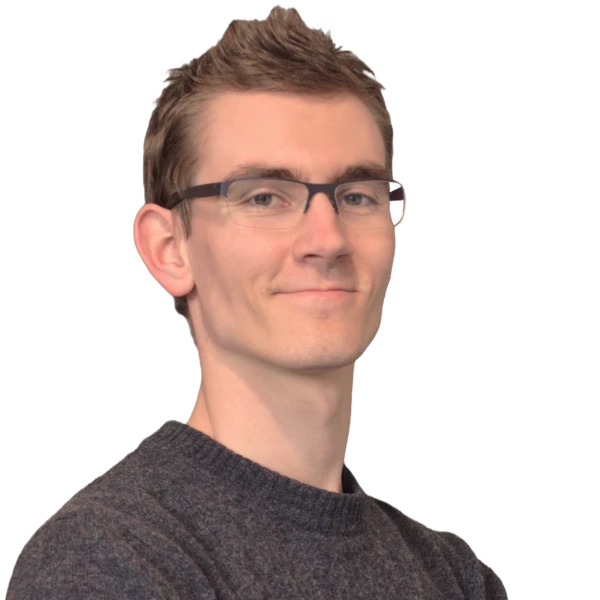
Moritz Nelle, founder of Haystack Imaging

About

Who's behind Haystack Imaging

Moritz Nelle · Founder

Moritz is an engineer based in the Netherlands, working where imaging, embedded hardware, and software meet. Haystack Imaging exists to give research groups, breeding companies, and technology firms access to that whole chain — sensor, firmware, model, data, and the platform it lands on — without the overhead of a large integrator.

In practice that means designing a camera and then writing the software that reads it; training a detection model and then building the site that publishes its output; printing the bracket that holds the whole thing together. Most of the work so far has been in agriculture, which remains the deepest specialism — but the underlying problem is rarely crop-specific. Livestock barns, food and drink production, robotics and lab instrumentation all present the same shape of problem.

If yours involves a camera, a sensor, or a pile of images that should be a table of numbers, there's a good chance it's the kind of haystack Haystack Imaging was built to search.

Contact

Got cameras, hardware, and a deadline?

Have a project in mind, or just want to see if Haystack Imaging is the right fit? Drop a line. Replies land within two business days, occasionally much faster.

Prefer LinkedIn? Reach out on LinkedIn →